
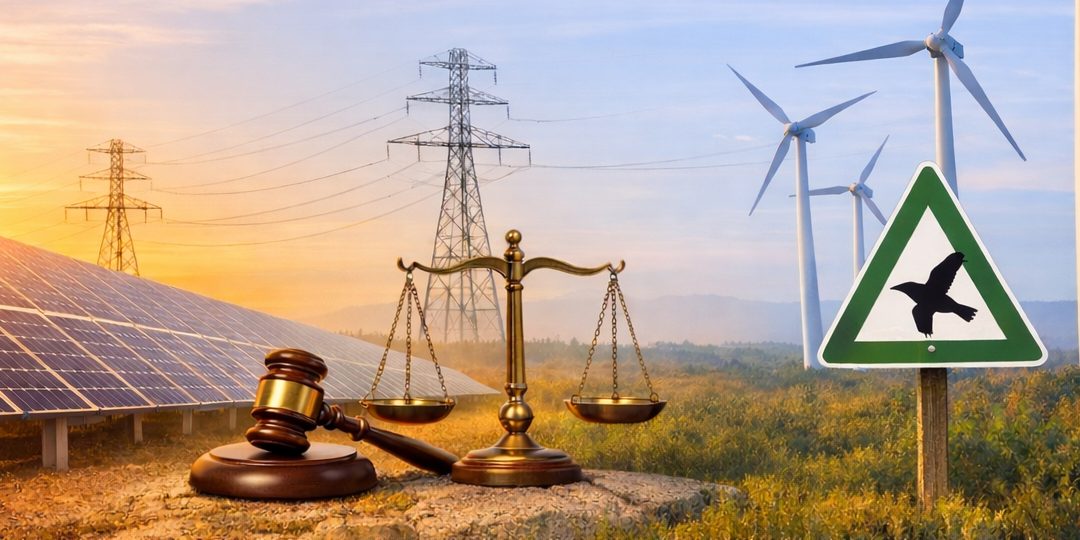
Geopolitical crises and instability in fossil fuel markets are increasingly encouraging states to accelerate the development of renewable energy sources. Investments in renewable energy enable countries to gradually reduce dependence on imported energy resources, increase the stability of their energy systems, and ensure greater resilience to global geopolitical crises. Solar power plants and wind farms have become one of the most dynamic segments of the energy market, as they contribute to greater energy independence and resilience to global disruptions in energy supply. However, behind these investments lies a complex legal and regulatory framework, which is why legal risks often represent a key factor affecting the timeline and profitability of such projects.
Factors that frequently determine the success or failure of an investment include unresolved property relations, limitations in spatial planning documents, difficulties related to connection to the electricity grid, and insufficiently defined contractual arrangements. Investors who analyze the legal framework, contractual structure, and regulatory requirements at an early stage can significantly reduce the risk of delays, disputes, and unforeseen costs.
One of the most common challenges relates to the legal status of land. For the construction of energy facilities, it is essential that property relations are fully resolved and that the construction is envisaged by the applicable planning documents. In practice, situations often arise where cadastral records do not correspond to the actual situation on the ground, where co-owners exist, inheritance issues remain unresolved, or various encumbrances are registered on the parcels.
A particular legal challenge is also the construction of infrastructure that accompanies energy projects, primarily cables, transmission lines, and access roads. In order for a power plant to be connected to the electricity grid, it is often necessary for lines to pass across several neighboring parcels owned by different individuals. In such cases, it is necessary to establish appropriate easements (for example, rights of way or easements for the installation of cables and transmission lines), which are usually regulated through agreements with landowners or, ultimately, through expropriation procedures.
If these issues are not resolved in a timely manner, a project may be significantly delayed or even blocked, since without legally regulated access to the grid and infrastructure it is not possible to obtain the necessary permits or commence construction. For this reason, a detailed legal due diligence of the land represents one of the most important steps in the development of any renewable energy project.
Urban planning risks can also significantly slow down project implementation. If the applicable spatial or urban plan does not foresee the construction of energy facilities at a particular location, an amendment to the planning documentation is required, which may take several years. In addition, limitations may arise from protective zones of infrastructure, watercourses, cultural heritage sites, or protected natural areas, as well as from urban planning parameters that determine the layout of facilities, access roads, or the height of wind turbines.
Another major challenge is connection to the electricity grid. In many cases, grid operators do not have sufficient capacity to connect new power plants, which leads to long waiting periods and uncertainty in the realization of investments. This issue is now considered one of the major bottlenecks of the energy transition in Europe and the region. According to the development plans of the transmission system, the number of requests for connecting solar and wind power plants already exceeds the capacities that the system can integrate.
In addition to technical and regulatory challenges, environmental factors also play an important role. Environmental risks represent another significant factor that can affect the timeline of solar and wind power plant construction. In practice, the most common challenges relate to the need to conduct environmental impact assessment procedures, particularly when a project is located near protected natural areas, habitats of protected species, or areas of importance for biodiversity. In the case of wind farms, special attention is given to the impact on bird migration routes and bats, while solar projects may raise issues related to the occupation of large land areas and the impact on local ecosystems. Additional risks arise if, at a later stage of the procedure, it is determined that a full environmental impact assessment study is required, which may prolong the permitting process and increase project costs. Therefore, an early environmental assessment of the location is essential for the timely management of risks in renewable energy projects.
All of the above demonstrates that the successful implementation of renewable energy projects does not depend solely on technical and financial aspects, but also on the timely identification of legal risks. For this reason, a thorough legal due diligence of land, planning documentation, and the regulatory framework represents one of the key steps in preparing any investment in this sector.
Disclaimer: This text is written for informational purposes only as well as to give general information and understanding of the law, not to provide specific legal advice. For any additional information feel free to contact us.


Send Email
office@gsm.legal
Privacy Policy
Make a Call
+381 11 3222 921
+381 11 3222 922
+381 11 3222 927